Salt vs. Salt-Free Water Softeners in Las Vegas
Hard water in Las Vegas? Learn the real differences between salt-based softeners and salt-free conditioners so you can choose the right system for your home.
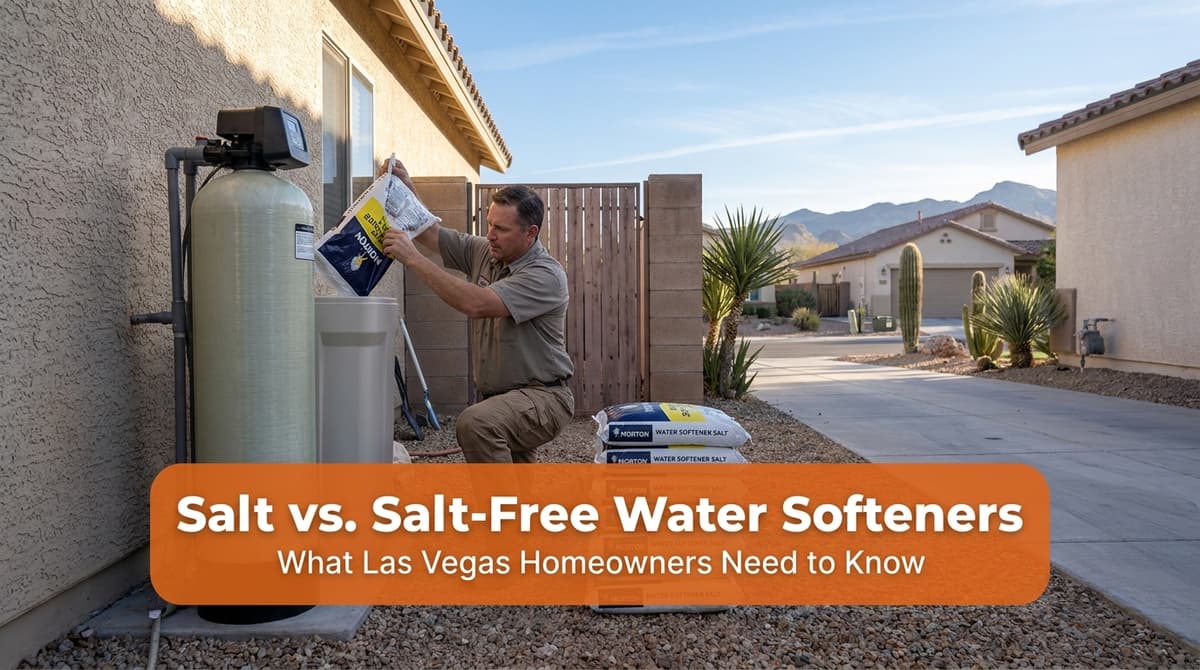
A Real Las Vegas Call About Salt vs. Salt-Free Softeners
We recently got a call from a customer — let’s call her Linda — who had one big question: “I’ve got really hard water here in North Las Vegas. Should I go with a salt-based softener or one of those salt-free systems?”
One of our technicians had already been to her home, tested the water, and left a brochure for a system similar to a Halo-style unit. After doing some online research and reading mixed reviews, Linda wasn’t convinced it would solve her hard water problems. She wanted a clear, side-by-side comparison before investing her cash in a system — and she wanted to make sure it would actually work in our tough Las Vegas water conditions.
If you’re in the Las Vegas Valley, Henderson, or North Las Vegas, you’re probably asking the same thing. Let’s walk through the same explanation we shared with Linda so you can make a confident choice for your home.
First Things First: How Hard Is Las Vegas Water?
When we tested Linda’s water, the reading was in the very hard range — which is common here. In many Las Vegas neighborhoods, hardness levels can run 15–25+ grains per gallon, sometimes higher. That’s why you see:
- White, chalky spots on faucets, shower doors, and dishes
- Scale buildup on shower heads and around fixtures
- Water heater efficiency dropping over time
- Dry skin and hair that never quite feels “rinsed”
In an area with moderate hardness, some salt-free systems can be fine. In a place like Las Vegas, the difference between salt-based and salt-free gets a lot more noticeable.
What a Salt-Based Water Softener Actually Does
With Linda, we started by explaining how a traditional salt-based softener works, because that’s the system most people have in mind.
Salt-based softeners use a process called ion exchange:
- Hardness minerals (calcium and magnesium) in the water are swapped for sodium (or sometimes potassium) ions.
- The hardness minerals are trapped in a resin tank.
- During regeneration, the system flushes those minerals down the drain using a brine solution.
The result: the water coming into your home is technically “soft” — the hardness minerals are removed, not just treated.
In practical terms for a Las Vegas homeowner, a correctly sized and set up salt-based system usually gives you:
- Significantly fewer water spots and scale on glass and fixtures
- Much less scale in your water heater and plumbing
- Soaps and detergents that lather and rinse better
- Softer feel on skin and hair
What Salt-Free Systems Do (and Don’t) Do
Linda’s main concern was that the salt-free system she’d read about “wouldn’t perform” in our hard water. Her confusion came from one key point: salt-free systems don’t actually soften water in the traditional sense.
Most salt-free units are better described as conditioners or scale inhibitors:
- They typically use media that changes the way hardness minerals behave.
- The calcium and magnesium stay in the water, but are less likely to stick and form hard scale on pipes and heating elements.
- Your hardness test numbers will usually look the same before and after.
That means you may still see:
- Some spotting on glass and fixtures (though it may wipe off easier)
- Hardness readings that don’t change, even though scale inside pipes may be reduced
- Less of that “silky soft” feel people associate with true soft water
In extremely hard water areas like North Las Vegas, homeowners sometimes expect a salt-free unit to give salt-based results. When that doesn’t happen, it shows up as negative reviews — just like the ones Linda found online.
Salt-Based vs. Salt-Free: Which Makes Sense in Las Vegas?
Here’s the same side-by-side we walked Linda through, focused on our desert water conditions:
When a Salt-Based Softener Is Usually the Better Choice
- Very hard water (like much of Las Vegas and North Las Vegas)
- You want to fix spotting and scaling as much as possible
- You’re concerned about water heater efficiency and lifespan
- You like the feel of true soft water for showers and laundry
The tradeoffs with a salt-based system are:
- You’ll need to buy and add salt periodically.
- The system uses some water for regeneration.
- If you’re on a very low-sodium diet, you may want a bypass line for drinking water or a reverse osmosis system at the kitchen sink.
When a Salt-Free Conditioner Might Make Sense
- You primarily care about reducing scale inside pipes and appliances, not the feel of the water.
- You don’t want to haul salt bags or deal with a brine tank.
- You’re on a septic system or have local restrictions on brine discharge.
- You understand the water will still test as “hard” and may still spot.
These can be a good tool when expectations are clear and the water isn’t as extreme as some Las Vegas neighborhoods — but we always explain that they are not a one-for-one replacement for salt-based softening here.
Key Questions to Ask Before You Choose a System
Just like Linda, you don’t have to become a water treatment engineer, but it helps to ask the right questions before you spend a few thousand dollars. Here are the ones we recommend:
- What is my actual water hardness number? (In grains per gallon or ppm.) Get it tested, don’t guess.
- Will this system change that hardness number? If not, it’s a conditioner, not a true softener.
- What will I realistically notice day to day? Spots, scale, soap lather, skin/hair feel.
- What maintenance is required? Salt refills, media replacement, cleaning, etc.
- How long is the warranty and what does it actually cover?
- Is the system sized for my home? (Number of bathrooms, people, and actual hardness level.)
Our Advice to Linda — and to Other Las Vegas Homeowners
After talking through her goals — fewer spots, better showers, and protecting a future tankless water heater — we recommended a properly sized salt-based softener for Linda’s North Las Vegas home. In her area’s hardness range, that option gave her the most predictable, noticeable improvement for the money.
We also told her what we tell every homeowner: there’s no one “best” system for everyone. There is only the system that matches your water, your expectations, and your budget.
If you’re in the Las Vegas area and debating between salt-based and salt-free, we’re happy to come out, test your water, walk you through the numbers, and explain what you can realistically expect from each option — just like we did with Linda. Once you understand how these systems work in our desert water, the right choice usually becomes pretty clear.